- Guest
- Politics
- 0 Comments
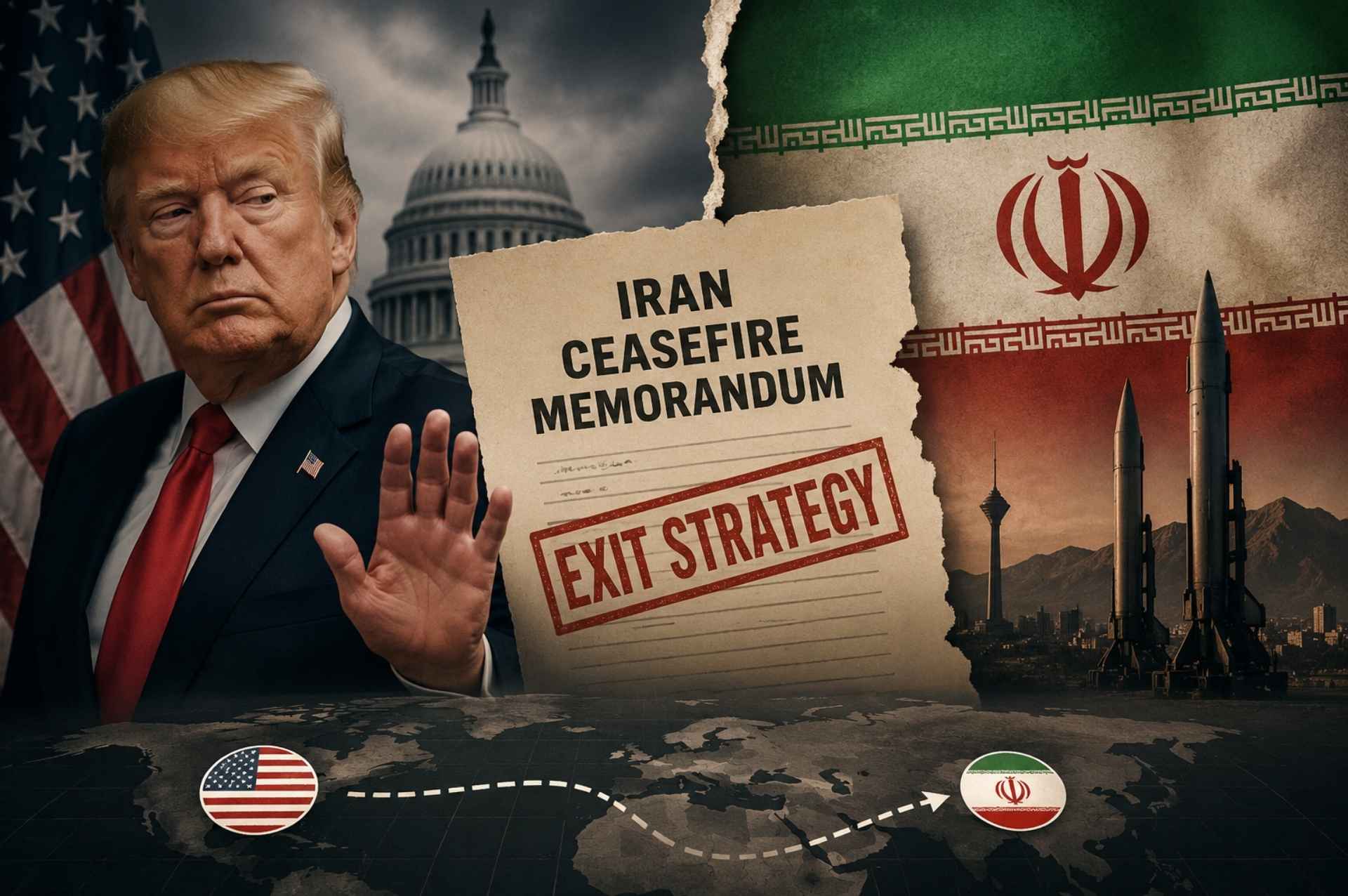
Why the US Is Quietly Trying to Exit Its Iran Ceasefire Memorandum
Three weeks ago, the United States and Iran stood in front of cameras and signed a deal meant to end a war. Today, the man who signed that same deal calls it “over.”
The collapse hasn’t happened all at once. It has come in pieces: a strike here, a retaliatory drone there, and a sanctions waiver quietly revoked.
The Iran ceasefire memorandum once promised a 60-day path to peace. Now it looks like a document neither side fully trusts. Understanding how the US-Iran MoU reached this point takes a closer look.
We need to review what we signed and what has already broken down.
We also need to see what the region could lose if the deal fails.
What the US-Iran MoU Actually Promised
People call the agreement at the center of this crisis the Islamabad Memorandum. It is a 14-point framework signed on June 17.
President Donald Trump and Iranian President Masoud Pezeshkian signed it. Pakistan served as the mediator. It followed months of fighting that came and went.
This began after US and Israeli strikes on Iran in late February.
Those strikes killed Iran’s Supreme Leader at the time.
They also triggered a broader regional war.
The Core Terms of the Islamabad Memorandum
At its core, the memorandum called for a permanent end to military operations “on all fronts.”
This included the Israel-Hezbollah conflict in Lebanon, even though Israel was not part of the talks.
It committed the US to lifting its naval blockade of Iranian ports. It committed Iran to allowing safe passage for commercial vessels through the Strait of Hormuz.
It also set a 60-day window for talks to resolve the toughest issues. These included Iran’s nuclear program and sanctions relief. They also included releasing frozen Iranian assets. They included a proposed $300 billion reconstruction package backed by the US and regional partners.
The 60-Day Clock and the 30-Day Naval Pullback
Two deadlines gave the memorandum its urgency. The US agreed to fully end its naval blockade within 30 days.
It also agreed to pull its forces back from Iran within 30 days of a final deal. Iran also agreed to help reopen Hormuz for normal shipping traffic.
However, it kept the right to manage the waterway with Oman. Both sides gave themselves 60 days — extendable by mutual consent — to convert this framework into a final, binding agreement.
The Cracks Appearing in Washington’s Commitment
Almost immediately, the ceasefire that underpinned the MoU began fraying. What began as isolated incidents in late June grew worse by early July.
It became the kind of exchange that makes diplomats nervous. Counterattacks met the attacks. Each side said the other broke the deal first.
Renewed US Strikes Despite the Ceasefire Terms
US Central Command has launched three major strike rounds on Iranian territory since the memorandum was signed. Washington framed each strike as retaliation for attacks on commercial ships in the Strait of Hormuz.
The latest wave on July 8 hit over 80 targets in Iran.
It followed projectiles striking three tankers while they crossed the strait. Iran’s Islamic Revolutionary Guard Corps responded by striking U.S. military positions in Kuwait and Bahrain. This pulled Gulf states into a conflict they hoped the MoU would end.
Trump’s own language has shifted just as sharply. Speaking to reporters at the NATO summit in Ankara, he said he now believes the Iran agreement is “over.” He added that further talks would be “a waste of time.”
He went further. He described Iran’s leaders in harsh personal terms. He repeated that his administration plans to pursue Iran’s “denuclearization.” He said they will do this no matter what happens to the talks.
Iran’s Rebuttal — Broken Trust on Both Sides
Tehran has not accepted the narrative that it is the one walking away. Iranian Foreign Minister Abbas Araghchi said the US strikes had rendered core elements of the war-ending agreement ineffective.
At the same time, parliamentary speaker and lead negotiator Mohammad Ghalibaf accused Washington of repeated MOU violations.
He linked them to the strikes, the return of oil sanctions, and ongoing Israeli operations in Lebanon. Analysts watching the talks note this is the third time the US struck Iran during active negotiations. In Tehran’s view, this pattern has made the 60-day process hard to trust.
Gulf States Caught in the Fallout
The renewed fighting hasn’t stayed contained between Washington and Tehran. Bahrain and Kuwait host US military sites. They were hit by IRGC strikes after the latest US action. This shows that any breakdown of the Iran ceasefire memorandum has consequences beyond the two signatories.
Why the Strait of Hormuz Remains the Flashpoint
Nearly every escalation traces back to the same chokepoint. Before the war, the Strait of Hormuz carried roughly a fifth of the world’s oil and liquefied natural gas.
Iran’s blockade of the waterway during the conflict caused a global energy crisis. Its promised reopening was one of the memorandum’s main selling points. Iran has often said control of Hormuz is its strongest leverage.
Araghchi said Iran plans to manage the waterway alone for a set time.
After that, Iran would allow traffic to fully return to normal.
Washington says this stance does not match the deal’s spirit.
Despite the violence, shipping data tells a more complicated story. Analytics firm Kpler recorded over 100 vessel transits through the strait from July 5 to July 7.
This suggests that even as diplomatic ties worsen, oil is still moving through.
The flow has stayed higher than many expected when the strait was first blockaded.
Reading the Signals: Tactical Pause or Collapsing Deal?
Regional analysts are split on how to interpret the pattern of strikes, statements, and walk-backs.
Some see a familiar rhythm. Both sides use brinkmanship to win concessions, then return to the table. This echoes earlier ceasefires in Lebanon and Gaza. Those truces survived repeated violations before they finally held.
Others argue that these breaches happen often. They say Trump’s public claim that the deal is “over” matters. They also note oil sanctions were reimposed after being waived to support peace talks. Together, this suggests a deeper plan. The administration may be testing how much pressure it can put on Iran’s nuclear stance. It may do this without fully ending diplomacy.
Analysts who closely track the negotiations note that Iran sees its control of Hormuz as leverage. It is unlikely to give it up easily. The blockade caused major economic harm to global energy markets. The broader war also became unpopular, even within the US. That leverage cuts both ways — it keeps Iran at the table, but it also gives Washington a ready justification for continued strikes whenever shipping incidents occur.
What Happens Next in the 60-Day Negotiation Window
The 60-day Clock that began on June 17 is still technically running. Still, every structural pillar it depends on — the naval blockade, the sanctions waiver, uninterrupted Hormuz traffic — has already been tested or broken at least once. The US has reimposed sanctions on Iranian oil sales effective July 7, ending a waiver that was meant to run through late August. Oil prices jumped more than 6% globally following the latest strikes, a sign that markets are pricing in the real possibility that the ceasefire memorandum does not survive its own negotiating window.
For now, Trump has left the door open a crack, saying negotiators may continue talking even as he personally considers the effort futile. Whether that ambiguity turns into a formal US exit from the memorandum, or whether the agreement limps forward through further rounds of strikes and denials, will likely become clear well before the 60 days are up.
پسرور کے منتخب نمائندے، ممبر صوبائی اسمبلی رانا فیاض احمد خان، اپنی انتخابی مہم کے وعدوں کو عملی جام...
- Guest
- 48 0
Recent Comments
- No comments yet. Be the first!